
After the ChatGPT phenomenon, one key question on the minds of teachers and parents is whether their students or children might use ChatGPT to copy paste answers instead of engaging in the rigorous process of learning. In light of this concern, many schools around the world have banned ChatGPT and similar tools.
It raises a key question: how can ChatGPT and other LLM-based tools be effectively utilized for learning and teaching?The answer is certainly ‘yes‘, but we need to implement specific guardrails to ensure safety, bias, and accuracy. While the topics of guardrails, bias handling, and safety deserve a full-fledged article, this piece focuses on how parents and teachers can leverage ChatGPT and other LLMs for quick wins.
Explain and Engage
A major challenge in traditional classroom teaching is the mismatch between students’ understanding and the standard explanations provided.It is not feasible to customize explanations based on each student’s understanding in a classroom setting due to limited resources. AI can help here. AI can assess a learner’s level, interests, and strengths through past interactions and tailor responses accordingly. For instance, AI can choose examples to explain from areas, a student already enjoys or finds engaging. For example, when explaining how a federal government structure works, which might feel dry for many students, AI can adapt the explanation using a student’s interest—say, football. This approach helps keep students engaged and fosters effective learning.

Deeper Dive via Interactive Learning
The traditional approach to learning feels more like a monologue—uninspiring and lifeless. It’s no wonder we’ve all had those moments of zoning out during a boring lecture or article.In contrast, imagine a scenario where you’re fully engrossed, constantly challenged, and your interest is kept alive throughout.
AI can significantly enhance interest and engagement by adopting any role or personality to create dynamic, interactive experiences. For instance, consider a student studying various forms of government along with their merits and demerits. With AI in debater role, the student could engage in a debate, take a side, or even play devil’s advocate to explore opposing perspectives and deepen their understanding.

Time travel Learning
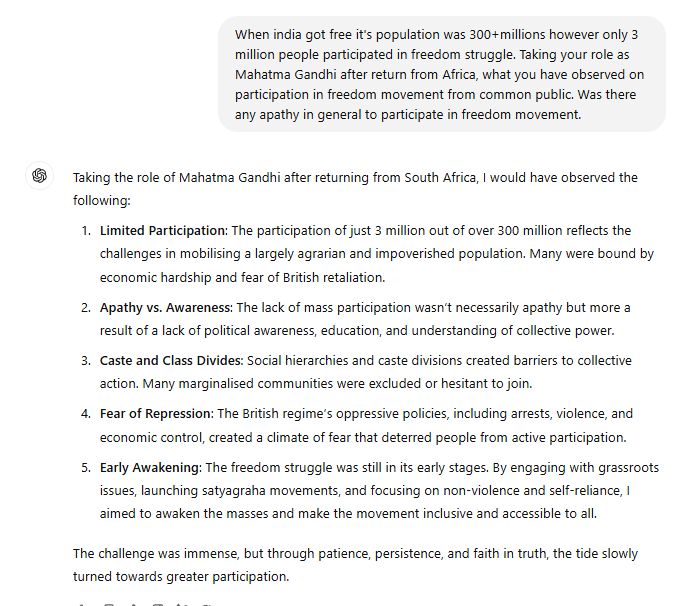
Holy cow! I can’t believe this has happened! Often, our reactions to historical events leave us baffled. We fail to grasp what might have culminated into this.
This can be easier to understand if we look at event from a time in history, place where event occurred , and societal. tribal or state belief perspective. This shift perspective can be achieved if we shift our thinking to use a persona or character for a particular point in time at a particular location for a particular society, tribe or state. It can be stimulated for human as well as a non-human character such as an organization or constitution.
Customise Project and Activities
AI can greatly enhance the learning experience for students by enabling parents and teachers to customise projects based on individual abilities and learning levels. By analysing a student’s strengths, weaknesses, and learning pace, AI-powered tools can suggest tailored project ideas that align with their academic needs and personal interests. For example, a student excelling in maths but struggling with language skills could be assigned a STEM-based project incorporating storytelling, encouraging holistic development. This personalisation not only keeps students engaged but also fosters a sense of achievement by offering tasks that are appropriately challenging without being overwhelming.
Moreover, AI provides real-time insights and recommendations to parents and teachers, enabling them to monitor progress and dynamically adapt projects as the student evolves.
Evaluate and Test
While multiple-choice options are convenient for testing, they don’t always capture a student’s full understanding. In contrast, written exams challenge students to articulate their reasoning, giving evaluators a clearer view of their problem-solving skills.
AI Can help in providing the constructive feedback on written response.It can deconstruct the thinking and based on the objective of exercise feedback response can be tuned. Many time response or answer of a question can’t be black and white but grey, such as in the field of philosophy, literature or political science even those can be answered with the help AI. Reading comprehension can be another area where AI can help beyond multiple choice answers.
Examples of AI in Action
- Philosophy: A student writes an essay on “The Ethics of Artificial Intelligence.” AI can evaluate how well the student presents arguments for and against, identifies logical fallacies, and offers alternative perspectives.
- Literature: In analysing a poem, AI can assess the student’s ability to interpret metaphors, themes, and tone while providing suggestions to refine their explanation.
- Political Science: For a debate on “The Role of Democracy in Global Governance,” AI can evaluate the balance of arguments, use of evidence, and depth of critical thinking.
- Reading Comprehension: Instead of simply selecting answers from a list, students could write a summary or interpretation of a passage. AI can provide feedback on key points missed, coherence, and language use.