
Tag: business

  • Turning Chaos into Control: Crisis Management Exercise

    Turning Chaos into Control: Crisis Management Exercise

    The more you sweat in the peace, the less you bleed in the war.

    I saw this scrawled on an army training wall—and it’s stuck with me ever since.

    In every crisis I’ve managed, one truth stands out: 80% of success comes from stress-testing your plan before chaos hits. A well-prepared team and organization not only respond effectively but also emerge stronger from any crisis.

    Recognize

    How do we recognize a crisis? Some are immediately visible, like an airline crash that makes global headlines. Others may be more localized—a worker trapped in a mine, a fire in a building, contamination in a food product, or even a viral negative tweet damaging an organization’s reputation.

    The first to detect a crisis is usually the operations team on the ground. The key question is: Does your organization have a structured mechanism to report incidents from the ground level to top management based on their impact? Timely detection, documentation, and escalation are the first steps in crisis management. Clearly defining who does what in a crisis ensures a swift and effective response.

    Readiness

    Once an incident is identified, the next step is determining who declares it a crisis or emergency to trigger the crisis management process. This decision is critical, as response time determines whether the situation remains contained or escalates into a full-blown organizational crisis.


    Defining Roles and Responsibilities

    Clearly defined roles and responsibilities are essential for an effective response

    • Who initiates the crisis management process?
    • Who leads the crisis response?
    • Who communicates and coordinates?
    • Who makes critical decisions?
    • What role does each department play?

    A well-structured Crisis Management Organizational Chart, led by a Crisis Management Commander, ensures clarity. Each department must have predefined roles based on the organization’s structure. Key responsibilities should be explicitly defined.

    Review

    Once a crisis is triggered, the focus shifts to execution. But the real question is: How do we ensure our crisis management process works?

    The answer lies in practice and evaluation. Regular crisis simulations help organizations identify strengths, expose weaknesses, and address gaps. In today’s VUCA (Volatile, Uncertain, Complex, and Ambiguous) world, every crisis is different. However, a well-rehearsed crisis management strategy enables swift and effective responses. During COVID, organizations with crisis management exercises handled the situation far better.

    Common Pitfalls in Crisis Management
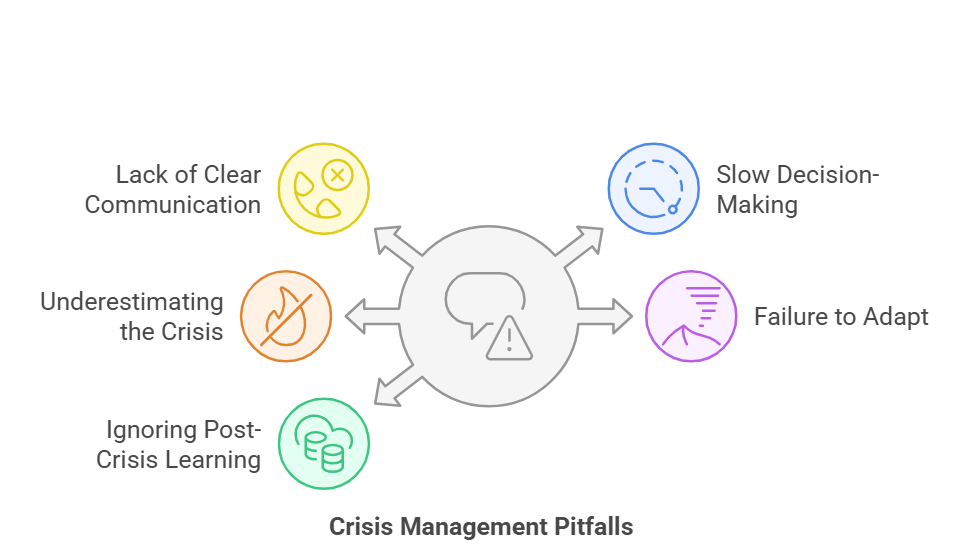
    Even the best organizations stumble. Some of the most common pitfalls include:

    • Lack of Clear Communication: Confusion over responsibilities or mixed messages can worsen a crisis. Clearly define what needs to be communicated, when, and by whom—to media, partners, employees, and suppliers.
    • Slow Decision-Making: A fire must be controlled and extinguished before it engulfs the entire jungle. Delayed responses often make situations worse. Crisis management organisation Chart need to ensure that backup for key resources are marked.
    • Underestimating the Crisis: Ignoring early warning signs or dismissing smaller incidents that could snowball into larger problems.In today’s digital age, it is not uncommon to see how a single piece of viral content can severely damage a reputation. Failing to act early can turn a manageable issue into a full-blown crisis.
    • Failure to Adapt: A real crisis is neither planned nor fully anticipated. No matter how many drills we conduct, the actual crisis will always unfold differently. Rigidly following predefined protocols without adapting to the situation’s unique challenges can hinder an effective response. Flexibility and situational awareness are key to managing crises successfully.
    • Ignoring Post-Crisis Learning: Organizations that fail to review and learn from past crises risk repeating the same mistakes. I have seen instances where basic oversights, such as misplaced cupboard keys or the lack of regular testing of crisis-handling kits and tools, have led to major inefficiencies during emergencies. Ensuring that all crisis management resources are fit for purpose and regularly maintained is crucial for effective response and preparedness.

    Role of Technology in Crisis Management

    Technology has revolutionized crisis response, making it faster, more coordinated, and highly efficient. Advanced platforms like Noggin, Everbridge, and D4H offer real-time solutions that enhance crisis management by enabling:

    • Incident Reporting & Tracking: Quickly detects, logs, and monitors crises as they develop.
    • Automated Alerts & Communication: Ensures timely and accurate information reaches all stakeholders.
    • Resource Allocation: Helps deploy teams and critical resources where they are needed most.
    • Data Analytics & Post-Crisis Review: Provides insights to refine strategies and improve future responses.

    By breaking down silos and fostering seamless coordination, technology ensures that crisis management is not just reactive but proactive, data-driven, and continuously improving.

    Crisis management is not just about reacting—it’s about being prepared, adaptable, and continuously improving. The best organizations don’t just rely on plans; they practice, refine, and evolve their tactics.

    A well-structured crisis management framework, combined with clear roles, effective communication, and the right technology, ensures that teams can respond with speed and confidence. But true resilience comes from learning—every crisis is an opportunity to sharpen strategies, identify gaps, and strengthen organizational preparedness.

    In the end, the practice of tactics ensures that when the real crisis hits, your organization doesn’t just survive—it emerges stronger.


  • Digital Transformation is Not Just About Technology—It’s About Business Growth

    Digital Transformation is Not Just About Technology—It’s About Business Growth

    In today’s rapidly evolving business landscape, digital transformation (DX) has emerged as a pivotal strategy for organizations aiming to achieve sustainable growth and maintain a competitive edge. Contrary to the common misconception that DX is merely about adopting new technologies, it fundamentally involves reimagining business models, processes, and customer engagements to drive value and innovation.

    The Misconception: Technology = Transformation

    Many organizations mistakenly equate digital transformation with the mere implementation of the latest technologies. This narrow perspective often leads to:

    • Isolated Systems: Technological solutions that operate in silos, failing to integrate with existing processes.
    • Employee Resistance: A lack of understanding or buy-in from staff who do not perceive the value of new tools.
    • Short-Lived Improvements: Temporary enhancements that do not contribute to long-term strategic objectives.

    True digital transformation transcends technology deployment; it necessitates a holistic approach that aligns technological initiatives with overarching business goals, cultural shifts, and process reengineering.

    How Digital Transformation Fuels Business Growth

    1. Creating New Revenue Streams

    • Digital Products and Services: Developing online offerings such as e-learning platforms, digital subscriptions, or virtual consultations.
    • Market Expansion: Leveraging digital channels to reach global audiences without the constraints of physical locations.

    2. Enhancing Operational Efficiency

    • Process Automation: Implementing robotic process automation (RPA) to handle repetitive tasks, reducing errors and freeing up human resources for strategic activities.
    • Data-Driven Decision Making: Utilizing analytics to gain insights into operations, leading to informed decisions and optimized workflows.

    3. Improving Customer Experience

    • Personalization: Employing AI to tailor products, services, and communications to individual customer preferences.
    • Omnichannel Engagement: Providing a seamless customer experience across various platforms, including mobile apps, websites, and social media.

    4. Increasing Agility and Scalability

    • Cloud Computing: Adopting cloud solutions to scale resources up or down based on demand, ensuring flexibility and cost-effectiveness.
    • Rapid Prototyping: Using digital tools to quickly develop and test new products or services, accelerating time-to-market.

    Case Study: The Digital Transformation Journey of a Mid-Sized Retailer

    Consider the example of a mid-sized apparel retailer that recognized the need to adapt to the digital age to stay competitive.

    Challenges Faced

    • Declining In-Store Sales: With the rise of e-commerce, foot traffic to physical stores was decreasing.
    • Inventory Management Issues: Overstocking certain items while understocking others led to increased costs and missed sales opportunities.
    • Limited Online Presence: The company’s website was outdated, offering a subpar user experience and limited e-commerce capabilities.

    Digital Transformation Initiatives

    1. E-Commerce Platform Development
      • Action: Launched a user-friendly online store with integrated payment gateways and mobile optimization.
      • Outcome: Online sales increased by 150% within the first year, compensating for declining in-store sales.
    2. Implementation of an AI-Driven Inventory Management System
      • Action: Deployed an AI-based system to predict demand trends and manage stock levels accordingly.
      • Outcome: Reduced excess inventory by 30% and improved stock availability for high-demand items, leading to a 20% increase in sales.
    3. Customer Relationship Management (CRM) System Integration
      • Action: Integrated a CRM system to collect and analyze customer data, facilitating personalized marketing campaigns.
      • Outcome: Email campaign engagement rates improved by 40%, and customer retention rates increased by 25%.
    4. Social Media and Digital Marketing Strategy
      • Action: Developed a comprehensive digital marketing strategy, leveraging social media platforms and search engine optimization (SEO) techniques.
      • Outcome: Website traffic grew by 60%, and the brand’s social media following doubled, enhancing brand visibility and customer engagement.

    Results Achieved

    • Revenue Growth: Overall revenue increased by 35% within two years post-transformation.
    • Operational Efficiency: Streamlined operations led to cost savings of approximately 15%.
    • Market Expansion: Gained customers from new demographics and geographic regions through enhanced online presence.

    From Vision to Execution: Key Learnings

    Align Digital Initiatives with Business Objectives

    • Ensure that technology implementations are directly linked to strategic goals such as revenue growth, cost reduction, or market expansion.

    Invest in Employee Training and Change Management

    • Equip staff with the necessary skills and foster a culture that embraces change to mitigate resistance and maximize the benefits of digital tools.

    Leverage Data Analytics

    • Utilize data to gain insights into customer behavior, operational performance, and market trends to inform decision-making.

    Focus on Customer-Centric Strategies

    • Place the customer at the center of digital transformation efforts to enhance satisfaction and loyalty.

    Adopt an Agile Approach

    • Implement flexible methodologies that allow for rapid testing, learning, and scaling of digital initiatives.

    Digital transformation is a comprehensive endeavor that extends beyond the adoption of new technologies. When aligned with strategic objectives, it enables businesses to drive growth, enhance customer experiences, and improve operational efficiency. Organizations that take a holistic approach—integrating technology, people, and processes—will be best positioned to thrive in the digital era.

  • IT Service Delivery: Trends and Innovations

    IT Service Delivery: Trends and Innovations

    The IT Service Paradigm Shift

    For years, IT service delivery was defined by reactive problem-solving—service desks fixing issues as they arose, rigid SLAs, and a focus on technical efficiency rather than user experience. However, the landscape is shifting rapidly, driven by AI, automation, and a demand for business-centric IT services. Today, organizations are not just looking for IT to “keep the lights on” but to drive strategic value.

    This article explores key trends shaping the future of IT service delivery, how they contrast with traditional models, and why organizations must embrace these changes to remain competitive

    1. Security-Centric IT Service Delivery

    Past: Perimeter-Based Security → Present: AI-Driven Zero Trust Models

    Traditional, IT security was about firewalls, VPNs, and access controls—essentially, guarding a defined perimeter. However, as cloud adoption, remote work, and mobile-first environments increased, this approach became ineffective.

    Today, AI-driven security frameworks have redefined IT service delivery by embedding security into every layer of IT operations. Predictive threat analysis and real-time anomaly detection ensure that IT teams can proactively mitigate threats before they cause disruptions.

    Case Study: Enhancing Threat Detection with AI-Driven Security Operations

    A major international airline was struggling with detecting and responding to cyber threats in real time. Traditional security monitoring relied heavily on manual analysis, leading to delayed responses to potential breaches. To address this, the airline deployed an AI-driven Security Information and Event Management (SIEM) system that continuously monitored network traffic, flagged suspicious activities, and automated threat containment. Within the first year, the airline reduced its incident response time by 70% and proactively prevented a ransomware attack that could have disrupted global flight operations.

    2. AI-Powered IT Service Management (ITSM)

    Past: Manual Ticket Handling → Present: AI-Driven Self-Healing IT

    Traditionally, IT service desks operated with tiered support models, where issues were escalated manually through human intervention. This led to slow resolution times and repetitive troubleshooting.

    Now, AI and automation have enabled self-healing IT environments—where systems detect, diagnose, and resolve common issues without human intervention. AI-powered virtual assistants handle L1 queries, freeing IT teams to focus on high-value work.

    Case Study: Healthcare Industry – A hospital system struggled with frequent downtime in its electronic medical records (EMR) system, delaying critical patient care. By integrating AI-driven ITSM, the hospital’s IT department could predict system failures, apply patches preemptively, and ensure doctors had uninterrupted access to patient records—enhancing hospital efficiency and patient outcomes.

    3. Experience-Level Agreements (XLAs) Over SLAs

    Past: Metrics Focused on Resolution Time → Present: User-Centric IT Service Metrics

    Service Level Agreements (SLAs) have long been the gold standard for IT performance measurement—focusing on technical compliance (e.g., ticket closure times, uptime guarantees). However, meeting SLAs doesn’t always translate to user satisfaction.

    Today, organizations are adopting Experience-Level Agreements (XLAs), which measure how IT services impact employee productivity and satisfaction. IT performance is evaluated based on real user feedback, usability, and frictionless digital experiences.

    Case Study: Automotive Industry – A global car manufacturer met all SLA targets, yet employees expressed frustration with slow design software and frequent system lags. By shifting to XLAs, IT teams started tracking employee experience metrics (e.g., latency complaints, software usability scores). With data-driven optimizations, the company improved design workflow efficiency, accelerating new vehicle development timelines.

    4. Predictive & Proactive IT Service Delivery

    Past: Break-Fix Model → Present: AI-Powered Predictive Maintenance

    Historically, IT operated in a break-fix model—problems were addressed only after they had occurred. This led to unexpected downtimes and costly disruptions.

    Now, predictive analytics and AI-driven automation enable IT teams to anticipate failures before they happen. By analyzing system health, usage trends, and anomaly detection, IT can proactively optimize infrastructure and prevent service outages.

    Case Study: Healthcare Industry – A diagnostic lab previously suffered from frequent system crashes during peak hours, delaying patient reports. After implementing AI-driven predictive maintenance, IT teams received early warnings of potential system overloads and preemptively scaled resources—ensuring uninterrupted access for thousands of patients daily.

    5. IT as a Business Enabler, Not Just a Support Function

    Past: IT as a Cost Center → Present: IT as a Strategic Asset

    In the past, IT was viewed as a cost center—a necessary expense for keeping operations running. IT investments were justified based on cost-cutting and efficiency gains, rather than strategic business value.

    Now, IT is recognized as a revenue enabler and competitive differentiator. Organizations leverage IT-driven innovation to create new business models, improve customer experience, and drive growth.

    The Future of IT Service Delivery

    IT service delivery is no longer about just meeting technical metrics—it’s about driving business outcomes, enhancing user experience, and proactively managing risks.

    To remain competitive, organizations must shift from reactive IT models to AI-powered, predictive, and business-centric IT strategies. CIOs and IT leaders must ask:

    • Are we still relying on SLAs, or are we moving toward experience-driven XLAs?
    • How well are we leveraging AI for predictive IT management?
    • Is IT a cost center in our company, or a strategic enabler of growth?

    What’s Next?

    How is your organization evolving its IT service delivery model? Share your thoughts in the comments.