Category: Transformation

  • Can a “Boring” CMDB Become a Boardroom Weapon?

    For most of its life, the Configuration Management Database (CMDB) has suffered from an image problem.
    It’s seen as necessary, dull, and operational—something you keep for audits, not for strategy.

    And yet, in the right hands, a CMDB can quietly shift power in the boardroom.

    Let me explain how.

    How a “Boring” CMDB Saved Millions During a Vendor Exit

    For years, a large retail enterprise outsourced the majority of its IT operations to a single vendor. Initially, the model worked. Over time, however, costs crept up, innovation slowed, and every improvement request hit the same wall:

    “The environment is too complex to untangle safely.”

    The unspoken message was clear: you’re stuck with us.

    The Real Problem (It Wasn’t the Vendor)

    The organisation didn’t truly understand its own technology estate.

    Applications, servers, integrations, and dependencies existed:

    • Partly in outdated documents
    • Partly in vendor-held knowledge
    • Mostly in people’s heads

    The CMDB technically existed—but only as a static asset register. It was poorly trusted, rarely used, and irrelevant to decision-making.

    Complexity wasn’t technical.It was informational.

    The Turning Point: A Dangerous Question

    A newly appointed CIO asked a deceptively simple question:

    “If we had to change vendors in six months, what would break first?”

    No one could answer with confidence.

    Instead of starting with contracts, legal clauses, or procurement strategies, the CIO chose an unexpected lever: the CMDB.

    But not as a compliance artefact.As a truth engine.

    What Changed in the CMDB

    The CMDB was redesigned around behaviour and impact, not inventory.

    Key shifts included:

    • Applications mapped to business capabilities
    • Infrastructure linked to application and service dependencies
    • Clear ownership defined across business, IT, and vendor
    • “Criticality” redefined in revenue, customer, and regulatory terms

    Within weeks, something interesting happened.

    Patterns emerged.

    The Revelation: Complexity Collapses Under Light

    The data told a very different story from the vendor narrative.

    • Nearly 60% of applications were loosely coupled
    • Many systems did not depend on proprietary vendor tooling
    • Some “high-risk” platforms were operationally simple
    • Some “minor” systems were quietly business-critical

    The myth of untouchable complexity collapsed—not loudly, but decisively.

    The Outcome: From Fear to Facts

    With CMDB-backed evidence:

    • The vendor exit was restructured into phased, manageable transitions
    • Negotiations shifted from emotion to data
    • Exit penalties were reduced
    • Timelines became realistic and defensible

    The vendor was replaced with no major outages.

    Savings: Several million pounds
    Bonus: The organisation finally owned its own knowledge

    The Real Lesson

    The CMDB didn’t just store data.
    It changed the power dynamic.

    Without a trusted CMDB:

    • Complexity feels emotional
    • Risk is exaggerated
    • Decisions are defensive

    With a trusted CMDB:

    • Complexity becomes measurable
    • Risk becomes manageable
    • Decisions become strategic

    This is why most CMDBs fail—and why a few succeed spectacularly.

    CMDB is not a system of record. It’s a system of reason

    CMDB Maturity Model: From Asset Register to Business Intelligence Engine

    CMDB maturity is not about how complete your data is.
    It’s about how confidently your organisation can make decisions using it.

    Here’s a practical five-level maturity model mapped directly to business outcomes.

    Level 1: Inventory Mode — The Compliance CMDB

    What it looks like

    • Static lists of servers, applications, licences
    • Manual or infrequent updates
    • Owned by ITSM or operations

    Business reality

    • CMDB exists to satisfy audits
    • Low trust, low usage

    Executive view

    • CIO: “We have one… somewhere.”
    • CFO: “Does this reduce cost?” (It doesn’t)

    Level 2: Technical Dependency Mode — The Operations CMDB

    What changes

    • Application-to-infrastructure mapping
    • Basic service models
    • Used during incidents and changes

    Business impact

    • Faster root cause analysis
    • Reduced MTTR

    What still hurts

    • Business impact is guessed, not known
    • CMDB still seen as technical, not strategic

    Executive view

    • CIO: “It helps during outages.”
    • CISO: “Still not enough for risk analysis.”

    Level 3: Business-Aware CMDB — The Decision Support Layer

    This is the inflection point.

    What evolves

    • Applications mapped to business capabilities
    • Clear service ownership (business + IT)
    • Criticality defined in business terms

    Business outcomes

    • Accurate impact assessments
    • Smarter change decisions
    • Better investment prioritisation

    Executive view

    • CIO: “I can justify decisions with data.”
    • CFO: “Now I see where the money actually goes.”

    Level 4: Risk, Cost & Governance Engine

    What becomes possible

    • Vendor dependency visibility
    • Licence and certificate automation
    • Support model and headcount optimisation
    • Audit and regulatory evidence on demand

    Business outcomes

    • Stronger vendor negotiations
    • Lower compliance risk
    • Cost avoidance—not just cost cutting

    Executive view

    • CFO: “This reduces financial exposure.”
    • CISO: “This is my control plane.”

    Level 5: Strategic Intelligence & Predictive CMDB

    Rare—but transformational.

    What differentiates it

    • Near real-time discovery
    • CMDB feeds architecture, cyber, ESG models
    • Predictive insights: “If we change X, Y will break”

    Business outcomes

    • Safer transformations
    • Faster M&A integration
    • Strategy execution backed by evidence

    Executive view

    • Board: “We understand our technology risk.”
    • CIO: “This is how IT leads the business.”

    Why Most Organisations Get Stuck at Level 2

    Because they optimise for:

    • Data accuracy over decision relevance
    • Tools over ownership
    • Completeness over confidence

    Mature CMDBs are not perfect.
    They are trusted enough to act on.

    Show me your CMDB KPIs, and I’ll show you how your IT really runs

    CMDB Maturity Model — KPI Mapping

    Level 1: Inventory Mode

    Goal: Prove existence and basic control

    • % of assets recorded vs procured
    • Audit exceptions
    • Data freshness

    Level 2: Technical Dependency Mode

    Goal: Improve operational stability

    • % of applications with dependencies mapped
    • MTTR
    • % of incidents with CI-level root cause

    Level 3: Business-Aware CMDB

    Goal: Enable impact-based decisions

    • % of services mapped to business capabilities
    • % of changes with business impact assessed
    • Change success rate

    Level 4: Risk, Cost & Governance

    Goal: Reduce exposure and optimise spend

    • Vendor concentration risk
    • Licence & certificate compliance
    • Cost per business service

    Level 5: Strategic & Predictive CMDB

    Goal: Enable foresight

    • % of changes simulated
    • Prediction accuracy
    • Time to assess M&A impact

    The One KPI That Matters at Every Level

    If you track only one metric, make it this:

    Decision Confidence Index

    % of major IT decisions backed by CMDB data

    Low CMDB accuracy + high confidence = danger
    Moderate accuracy + high confidence = maturity

    Final Thought

    CMDBs don’t fail because they’re boring.
    They fail because organisations ask too little of them.

    Used correctly, a CMDB doesn’t just support IT—it reshapes how the business understands risk, cost, and complexity.

    And that’s when something boring becomes powerful.

  • Turning Chaos into Control: Crisis Management Exercise

    Turning Chaos into Control: Crisis Management Exercise

    The more you sweat in the peace, the less you bleed in the war.

    I saw this scrawled on an army training wall—and it’s stuck with me ever since.

    In every crisis I’ve managed, one truth stands out: 80% of success comes from stress-testing your plan before chaos hits. A well-prepared team and organization not only respond effectively but also emerge stronger from any crisis.

    Recognize

    How do we recognize a crisis? Some are immediately visible, like an airline crash that makes global headlines. Others may be more localized—a worker trapped in a mine, a fire in a building, contamination in a food product, or even a viral negative tweet damaging an organization’s reputation.

    The first to detect a crisis is usually the operations team on the ground. The key question is: Does your organization have a structured mechanism to report incidents from the ground level to top management based on their impact? Timely detection, documentation, and escalation are the first steps in crisis management. Clearly defining who does what in a crisis ensures a swift and effective response.

    Readiness

    Once an incident is identified, the next step is determining who declares it a crisis or emergency to trigger the crisis management process. This decision is critical, as response time determines whether the situation remains contained or escalates into a full-blown organizational crisis.


    Defining Roles and Responsibilities

    Clearly defined roles and responsibilities are essential for an effective response

    • Who initiates the crisis management process?
    • Who leads the crisis response?
    • Who communicates and coordinates?
    • Who makes critical decisions?
    • What role does each department play?

    A well-structured Crisis Management Organizational Chart, led by a Crisis Management Commander, ensures clarity. Each department must have predefined roles based on the organization’s structure. Key responsibilities should be explicitly defined.

    Review

    Once a crisis is triggered, the focus shifts to execution. But the real question is: How do we ensure our crisis management process works?

    The answer lies in practice and evaluation. Regular crisis simulations help organizations identify strengths, expose weaknesses, and address gaps. In today’s VUCA (Volatile, Uncertain, Complex, and Ambiguous) world, every crisis is different. However, a well-rehearsed crisis management strategy enables swift and effective responses. During COVID, organizations with crisis management exercises handled the situation far better.

    Common Pitfalls in Crisis Management

    Even the best organizations stumble. Some of the most common pitfalls include:

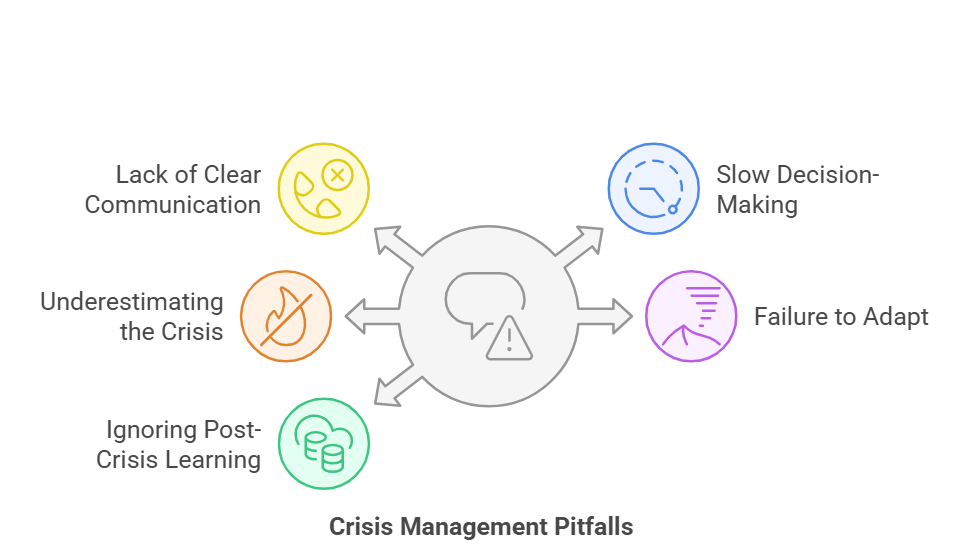
    • Lack of Clear Communication: Confusion over responsibilities or mixed messages can worsen a crisis. Clearly define what needs to be communicated, when, and by whom—to media, partners, employees, and suppliers.
    • Slow Decision-Making: A fire must be controlled and extinguished before it engulfs the entire jungle. Delayed responses often make situations worse. Crisis management organisation Chart need to ensure that backup for key resources are marked.
    • Underestimating the Crisis: Ignoring early warning signs or dismissing smaller incidents that could snowball into larger problems.In today’s digital age, it is not uncommon to see how a single piece of viral content can severely damage a reputation. Failing to act early can turn a manageable issue into a full-blown crisis.
    • Failure to Adapt: A real crisis is neither planned nor fully anticipated. No matter how many drills we conduct, the actual crisis will always unfold differently. Rigidly following predefined protocols without adapting to the situation’s unique challenges can hinder an effective response. Flexibility and situational awareness are key to managing crises successfully.
    • Ignoring Post-Crisis Learning: Organizations that fail to review and learn from past crises risk repeating the same mistakes. I have seen instances where basic oversights, such as misplaced cupboard keys or the lack of regular testing of crisis-handling kits and tools, have led to major inefficiencies during emergencies. Ensuring that all crisis management resources are fit for purpose and regularly maintained is crucial for effective response and preparedness.

    Role of Technology in Crisis Management

    Technology has revolutionized crisis response, making it faster, more coordinated, and highly efficient. Advanced platforms like Noggin, Everbridge, and D4H offer real-time solutions that enhance crisis management by enabling:

    • Incident Reporting & Tracking: Quickly detects, logs, and monitors crises as they develop.
    • Automated Alerts & Communication: Ensures timely and accurate information reaches all stakeholders.
    • Resource Allocation: Helps deploy teams and critical resources where they are needed most.
    • Data Analytics & Post-Crisis Review: Provides insights to refine strategies and improve future responses.

    By breaking down silos and fostering seamless coordination, technology ensures that crisis management is not just reactive but proactive, data-driven, and continuously improving.

    Crisis management is not just about reacting—it’s about being prepared, adaptable, and continuously improving. The best organizations don’t just rely on plans; they practice, refine, and evolve their tactics.

    A well-structured crisis management framework, combined with clear roles, effective communication, and the right technology, ensures that teams can respond with speed and confidence. But true resilience comes from learning—every crisis is an opportunity to sharpen strategies, identify gaps, and strengthen organizational preparedness.

    In the end, the practice of tactics ensures that when the real crisis hits, your organization doesn’t just survive—it emerges stronger.

  • From the Assembly Line to AI Systems—Redefining Work and the Human Role

    From the Assembly Line to AI Systems—Redefining Work and the Human Role

    In the early 20th century, Henry Ford revolutionized manufacturing with the assembly line. His approach was simple but powerful: humans are excellent at repetitive tasks. By breaking production into specialized, repeatable steps, factories became more efficient, output skyrocketed, and products became more affordable. It was a system built on speed, precision, and scalability.

    Fast forward to today, and we are experiencing another seismic shift—this time driven by Artificial Intelligence (AI). While the assembly line relied on human labour repetition, software and automation have taken over mental repetitive tasks, streamlining efficiency like never before.

    However, AI isn’t stopping at repetitive work. Consider this: AI Co-pilots are now replacing manual note-taking, summarizing year-long email chains in seconds, condensing 200-page reports into key insights, and instantly answering complex queries. With Large Language Models (LLMs), even creative and strategic tasks—writing, designing, summarizing, and decision-making—are increasingly within reach of algorithms. The boundaries between roles and industries are blurring. A former copyeditor is now training AI models, combining linguistic expertise with technology. This reflects a broader trend—where the assembly line once locked workers into rigid roles, AI is demanding versatility, adaptability, and continuous learning. Humans are shifting from being cogs in a machine to becoming conductors of a symphony.

    So, how do we stay ahead in this evolving landscape? First, embrace interdisciplinary learning. Understanding elements of coding, design, and data analysis—once considered niche skills—can now open new opportunities. Second, focus on what AI cannot replicate—empathy, intuition, creativity, and human connection. The assembly line optimized efficiency; AI is shaping agility and adaptability as the new competitive advantage.

    The future isn’t about AI replacing humans—it’s about humans and AI working together. Those who adapt will not only stay relevant but lead the transformation.

  • Digital Transformation is Not Just About Technology—It’s About Business Growth

    Digital Transformation is Not Just About Technology—It’s About Business Growth

    In today’s rapidly evolving business landscape, digital transformation (DX) has emerged as a pivotal strategy for organizations aiming to achieve sustainable growth and maintain a competitive edge. Contrary to the common misconception that DX is merely about adopting new technologies, it fundamentally involves reimagining business models, processes, and customer engagements to drive value and innovation.

    The Misconception: Technology = Transformation

    Many organizations mistakenly equate digital transformation with the mere implementation of the latest technologies. This narrow perspective often leads to:

    • Isolated Systems: Technological solutions that operate in silos, failing to integrate with existing processes.
    • Employee Resistance: A lack of understanding or buy-in from staff who do not perceive the value of new tools.
    • Short-Lived Improvements: Temporary enhancements that do not contribute to long-term strategic objectives.

    True digital transformation transcends technology deployment; it necessitates a holistic approach that aligns technological initiatives with overarching business goals, cultural shifts, and process reengineering.

    How Digital Transformation Fuels Business Growth

    1. Creating New Revenue Streams

    • Digital Products and Services: Developing online offerings such as e-learning platforms, digital subscriptions, or virtual consultations.
    • Market Expansion: Leveraging digital channels to reach global audiences without the constraints of physical locations.

    2. Enhancing Operational Efficiency

    • Process Automation: Implementing robotic process automation (RPA) to handle repetitive tasks, reducing errors and freeing up human resources for strategic activities.
    • Data-Driven Decision Making: Utilizing analytics to gain insights into operations, leading to informed decisions and optimized workflows.

    3. Improving Customer Experience

    • Personalization: Employing AI to tailor products, services, and communications to individual customer preferences.
    • Omnichannel Engagement: Providing a seamless customer experience across various platforms, including mobile apps, websites, and social media.

    4. Increasing Agility and Scalability

    • Cloud Computing: Adopting cloud solutions to scale resources up or down based on demand, ensuring flexibility and cost-effectiveness.
    • Rapid Prototyping: Using digital tools to quickly develop and test new products or services, accelerating time-to-market.

    Case Study: The Digital Transformation Journey of a Mid-Sized Retailer

    Consider the example of a mid-sized apparel retailer that recognized the need to adapt to the digital age to stay competitive.

    Challenges Faced

    • Declining In-Store Sales: With the rise of e-commerce, foot traffic to physical stores was decreasing.
    • Inventory Management Issues: Overstocking certain items while understocking others led to increased costs and missed sales opportunities.
    • Limited Online Presence: The company’s website was outdated, offering a subpar user experience and limited e-commerce capabilities.

    Digital Transformation Initiatives

    1. E-Commerce Platform Development
      • Action: Launched a user-friendly online store with integrated payment gateways and mobile optimization.
      • Outcome: Online sales increased by 150% within the first year, compensating for declining in-store sales.
    2. Implementation of an AI-Driven Inventory Management System
      • Action: Deployed an AI-based system to predict demand trends and manage stock levels accordingly.
      • Outcome: Reduced excess inventory by 30% and improved stock availability for high-demand items, leading to a 20% increase in sales.
    3. Customer Relationship Management (CRM) System Integration
      • Action: Integrated a CRM system to collect and analyze customer data, facilitating personalized marketing campaigns.
      • Outcome: Email campaign engagement rates improved by 40%, and customer retention rates increased by 25%.
    4. Social Media and Digital Marketing Strategy
      • Action: Developed a comprehensive digital marketing strategy, leveraging social media platforms and search engine optimization (SEO) techniques.
      • Outcome: Website traffic grew by 60%, and the brand’s social media following doubled, enhancing brand visibility and customer engagement.

    Results Achieved

    • Revenue Growth: Overall revenue increased by 35% within two years post-transformation.
    • Operational Efficiency: Streamlined operations led to cost savings of approximately 15%.
    • Market Expansion: Gained customers from new demographics and geographic regions through enhanced online presence.

    From Vision to Execution: Key Learnings

    Align Digital Initiatives with Business Objectives

    • Ensure that technology implementations are directly linked to strategic goals such as revenue growth, cost reduction, or market expansion.

    Invest in Employee Training and Change Management

    • Equip staff with the necessary skills and foster a culture that embraces change to mitigate resistance and maximize the benefits of digital tools.

    Leverage Data Analytics

    • Utilize data to gain insights into customer behavior, operational performance, and market trends to inform decision-making.

    Focus on Customer-Centric Strategies

    • Place the customer at the center of digital transformation efforts to enhance satisfaction and loyalty.

    Adopt an Agile Approach

    • Implement flexible methodologies that allow for rapid testing, learning, and scaling of digital initiatives.

    Digital transformation is a comprehensive endeavor that extends beyond the adoption of new technologies. When aligned with strategic objectives, it enables businesses to drive growth, enhance customer experiences, and improve operational efficiency. Organizations that take a holistic approach—integrating technology, people, and processes—will be best positioned to thrive in the digital era.

  • Lessons Learned from Managing Transition Projects

    Lessons Learned from Managing Transition Projects

    Transition management is a high-stakes process that demands precision, foresight, and control. Over the years, I’ve encountered various challenges while handling transitions, and certain lessons have become non-negotiable for a smooth execution. Here are the key takeaways from my experience

    Clearly Define the Objective and Scope

    One of the biggest mistakes in transition projects is an evolving or unclear objective. A transition should not accidentally morph into a transformation unless that is the defined goal. If transformation is the objective, it must be explicitly stated in the scope from the outset.

    Another crucial aspect of scope clarity is handling legacy systems. The plan should specify:

    • Will the legacy system be decommissioned, integrated, or maintained in parallel?
    • What will be the data migration and security considerations?
    • How will the transition team manage dependencies on the legacy infrastructure?

    Without a well-defined scope, transitions can spiral into endless delays and confusion.

    The Discovery Phase Is Always a Challenge – Plan for It

    The current state assessment is often the trickiest part of a transition. Common challenges include:

    • Incomplete or outdated documentation
    • Hidden dependencies on legacy systems
    • Knowledge gaps due to vendor lock-in

    Without a structured discovery phase, transitions end up dealing with surprises mid-way, causing major disruptions. A well-planned knowledge transfer framework can mitigate this risk.

    In many projects, the discovery phase often overlooks infrastructure components, departmental application running in isolation, Commercial off-the-shelf (COTS) software leading to significant challenges. In one instance, 25% of the inventory was missed, requiring extensive replanning to integrate the overlooked elements. This oversight resulted in delays, increased effort, and project disruptions.

    Such gaps highlight the need for a more thorough discovery process and built-in contingencies, such as buffers and contractual clauses, to mitigate risks and ensure smoother execution.

    Crystal-Clear Communication Strategy

    Transitions involve multiple stakeholders:

    • The incumbent vendor managing the existing system
    • The transition management team overseeing the process
    • The business stakeholders impacted by the change

    To avoid misalignment, establish a robust communication plan covering:

    • Stakeholder mapping: Who needs to be informed, consulted, or involved?
    • Frequency of updates: Daily stand-ups, weekly reports, or milestone check-ins?
    • Communication channels: Emails, dashboards, MS Teams/Slack, or formal meetings?

    Any misstep in communication can lead to friction, delays, or stakeholder resistance.

    Strong Governance Framework

    Governance provides the guardrails for a transition. Define:

    • Meeting cadence: Weekly governance meetings? Monthly steering committees?
    • Decision-making hierarchy: Who approves changes or escalates risks?
    • Accountability: Who owns which part of the transition plan?

    Without structured governance, projects drift into chaos, with no clear resolution path for bottlenecks.

    Compliance Cannot Be an Afterthought – A Costly Case Study

    Regulatory compliance is often underestimated, but it can break a project if not planned properly.

    Case Study: During a transition project for a medical manufacturer’s IT infrastructure, GxP compliance was overlooked in the planning stage. GxP regulations ensure product safety and quality in life sciences, making them non-negotiable for such industries.

    As a result of this oversight, the entire data center had to be rebuilt to ensure it met compliance standards. This included:

    • Ensuring all installations met GxP compliance
    • Completing Installation Qualification (IQ), Operational Qualification (OQ), and Performance Qualification (PQ) documentation

    This mistake led to significant delays, increased costs, and regulatory scrutiny. For industries with strict compliance needs, failing to consider regulatory requirements upfront can jeopardize business continuity.

    Key takeaway: Always engage compliance experts early in the transition to avoid costly rework.

    Rigorous Risk Management

    Risk is inevitable, but surprises should not be. Establish a risk management framework with:

    • A clear risk log identifying potential transition risks
    • Regular risk review meetings separate from governance meetings
    • Mitigation plans with defined responses for each identified risk

    Proactively managing risks prevents last-minute firefighting and costly project delays.

    Transition management is an art and a science. Success hinges on scope clarity, communication, governance, compliance, risk management, and a robust discovery phase. Getting these elements right ensures a smooth, predictable, and controlled transition—without unnecessary disruptions

  • From cost centre to business driver-The evolving role of IT leadership

    From cost centre to business driver-The evolving role of IT leadership

    The role of IT leaders has changed. It’s no longer just managing infrastructure and keeping systems running, IT executives must now drive business growth, shape strategy, and influence the boardroom.

    Technology needs to move from a bottom-line discussion to a top-line one. IT must no longer be seen as a cost centre but as a revenue enabler. This shift requires IT leaders to transition from operators to business executives, from order takers to decision-makers.

    This article explores how IT leaders can successfully make this transition, with real-world case studies and actionable strategies.

    The IT leadership evolution: key phases

    IT as a support function (pre-2000s)

    • IT was primarily responsible for cost efficiency and operational stability.
    • Businesses viewed IT as a back-office function, with limited strategic influence.

    IT as a strategic enabler (2000s–2010s)

    • The rise of cloud computing, ERP, and digital transformation positioned IT as a key driver of business efficiency.
    • IT leaders started participating in cross-functional strategy discussions.

    IT as a business driver (2020s and beyond)

    • IT is no longer just supporting strategy—it is shaping business opportunities.
    • IT leaders now focus on AI, data monetisation, cybersecurity resilience, and digital revenue models.

    The New Boardroom Expectation: IT as a Revenue Generator

    What the Board Expects from IT Today

    • Cybersecurity and Risk Management – IT leaders must quantify cybersecurity risks in financial terms.
    • Revenue Contribution – IT should enable new digital revenue streams, such as AI-driven products and data monetisation.
    • Competitive Edge – IT must differentiate the company through technology-driven customer experiences.

    Boardroom Strategy for IT Leaders

    • Speak in business terms, not just technology (e.g., “How AI can increase customer retention by 20%” instead of “We need an AI-powered CRM”).
    • Showcase IT’s direct impact on revenue growth, not just cost savings.
    • Use real business cases and ROI metrics to demonstrate IT’s value.

    Case Study: Domino’s Pizza – IT as a Competitive Advantage

    Domino’s shifted from a food company to a technology company that sells pizza.

    Invested in AI-driven ordering, voice assistants, and predictive analytics to improve delivery times.

    Result: Digital channels now account for over 75% of total sales, making it an industry leader in customer experience and operational efficiency.

    From IT Leader to Business Leader: Practical Steps

    To move from an operational role to a strategic leadership position, IT executives must shift their approach. Instead of focusing solely on infrastructure and support, they should actively engage in shaping business strategies, driving growth, and influencing key decisions.

    Key Actions to Take

    1. Understand Business KPIs – Learn about revenue, profit margins, and customer acquisition metrics to align IT projects with business goals.
    2. Build Cross-Functional Partnerships – Engage with sales, marketing, and finance teams to ensure IT supports revenue-generating initiatives.
    3. Quantify IT’s Business Impact – Present IT initiatives in terms of cost savings, revenue potential, and customer experience improvements.
    4. Enhance Financial Acumen – Develop a strong understanding of investment decisions and return on technology spend.
    5. Position IT as a Growth Engine – Demonstrate how technology drives top-line revenue rather than just reducing costs.
    6. Develop a Digital Business Model – Identify new revenue streams from AI, data, and cloud services to transform IT into a profit centre.
    7. Lead with Data-Driven Insights – Use analytics to support boardroom decision-making and influence strategic discussions.
    8. Invest in Talent Development – Train IT teams to focus on business impact, not just technical execution.

    Case Study: UPS – Turning Data Into a Competitive Edge

    • UPS leveraged advanced data analytics and AI to optimise delivery routes through its ORION system.
    • The system analyses 200,000 route optimisations per minute, reducing fuel costs and increasing delivery efficiency.
    • Result: Saved over 10 million gallons of fuel annually, leading to a $300M annual cost reduction while enhancing delivery speed and customer satisfaction.

    Case Study: CarMax – IT-Driven Revenue Growth

    • CarMax, a used car retailer, shifted to a data-driven, digital-first approach.
    • Implemented AI-powered predictive pricing models, leading to higher inventory turnover and better margins.
    • Built a seamless online-to-offline buying experience, significantly increasing digital sales conversions.
    • Result: IT transformed from a cost centre to a key revenue enabler, contributing to record-breaking revenue growth.

    The Future of IT Leadership: What’s Next?

    AI and Automation – IT leaders must drive AI integration for business growth.

    • Data Monetisation – Turning company data into a competitive asset.
    • Sustainability in IT – Green computing and ethical AI as key boardroom discussions.
    • CIO to CEO Pathway – More IT leaders will transition into general business leadership roles.

    Case Study: Ocado – AI and Robotics as Growth Drivers

    • Ocado, a UK-based online grocer, invested heavily in AI-powered warehouse automation.
    • Built an autonomous robotic fulfilment system, enabling faster order processing with fewer human resources.
    • Result: IT transformed Ocado into a global technology provider, licensing its platform to retailers worldwide.

    Final Takeaways: How IT Leaders Can Stay Ahead

    • Shift IT discussions from cost savings to revenue growth.
    • Become a trusted business advisor to the CEO and board.
    • Align IT projects with business growth and customer experience improvements.
    • Develop strong financial and business acumen to influence decision-making.
    • Focus on AI, data, and digital innovation to drive business transformation.

    IT Leadership Is Business Leadership

    IT must transition from being a support function to a strategic business driver. The best IT leaders are those who speak the language of business, influence the boardroom, and drive digital revenue growth.

    Whether you’re a senior IT manager aiming for a CIO role or a CIO looking to transition into a broader business role, the key is to think beyond technology and focus on business outcomes.

    The future of IT leadership is clear: from order takers to decision-makers, from cost centres to growth engines.

  • Transforming IT Operations with AI Agents: A Practical Framework for Efficient Transformation

    Transforming IT Operations with AI Agents: A Practical Framework for Efficient Transformation

    As IT operations grow increasingly complex, AI agents offer a transformative solution by automating routine tasks, enhancing efficiency, and reducing operational risks. However, transitioning from traditional IT operations to AI-powered IT Ops (AIOps) requires a structured approach. This article explores key use cases, transition strategies, challenges, and low-hanging fruits to build stakeholder confidence.

    AI Agent Use Cases in IT Operations

    1. Incident Management & Resolution

    Current State:

    • IT teams manually triage and categorise incidents, leading to delays and inconsistencies.
    • Root cause analysis is time-consuming and often reactive rather than proactive.
    • High reliance on human intervention for issue resolution.

    AI-Driven Improvements:

    • AI-driven automated ticketing and routing, ensuring quicker response times.
    • Machine learning models identify root causes faster by analysing historical incident data.
    • Self-healing systems automatically apply fixes, reducing the need for manual intervention.

    2. Performance Monitoring & Anomaly Detection

    Current State:

    • IT teams rely on static threshold-based alerts, leading to false positives and alert fatigue.
    • Manual log analysis makes it difficult to detect anomalies in real time.
    • Downtime incidents are often detected only after they impact users.

    AI-Driven Improvements:

    • AI-powered log analysis detects deviations and patterns that indicate potential issues.
    • Real-time monitoring with proactive alerts helps prevent incidents before they escalate.
    • Adaptive thresholding dynamically adjusts alerts, reducing noise and improving accuracy.

    3. Capacity Planning & Resource Optimisation

    Current State:

    • Resource allocation is often based on historical trends and static rules, leading to overprovisioning or underutilisation.
    • IT teams manually forecast demand, which is prone to errors.
    • Scaling infrastructure requires human oversight, making it slow and inefficient.

    AI-Driven Improvements:

    • Predictive analytics forecast resource demand with higher accuracy.
    • Auto-scaling infrastructure dynamically adjusts based on real-time usage patterns.
    • AI-driven cost-optimisation strategies ensure efficient resource allocation, reducing expenses.

    4. Security & Compliance Automation

    Current State:

    • Security threats are often identified manually, leading to delayed responses.
    • Patch management is inconsistent, increasing vulnerability to cyberattacks.
    • Compliance audits require extensive manual effort and documentation.

    AI-Driven Improvements:

    • AI-based threat detection analyses behavioural patterns to detect anomalies early.
    • Automated patch management ensures timely security updates without manual intervention.
    • Continuous compliance auditing reduces manual workload and improves regulatory adherence.

    5. Automated DevOps & CI/CD Pipelines

    Current State:

    • Code reviews and quality checks are done manually, slowing down development cycles.
    • Testing processes are largely human-driven, making them time-consuming and prone to errors.
    • Failed deployments require manual intervention, delaying software releases.

    AI-Driven Improvements:

    • AI-driven code quality analysis and bug prediction improve software reliability.
    • Intelligent test automation accelerates testing cycles with better coverage.
    • Auto-remediation of failed deployments ensures smooth and continuous software releases.

    Transitioning from Traditional IT Ops to AI-driven IT Ops

    Here’s the article with the steps replaced by normal numbers:

    Transitioning from Traditional IT Ops to AI-driven IT Ops

    1. Assess Current IT Operations
      • Identify inefficiencies, bottlenecks, and high-impact pain points.
      • Evaluate automation maturity and monitoring capabilities.
      • Assess data quality, accessibility, and AI readiness.
    2. Define AI Adoption Roadmap
      • Prioritise AI use cases based on business impact and feasibility.
      • Set clear goals, KPIs, and success metrics.
      • Develop a phased implementation plan for seamless integration.
    3. Identify Quick-Win Use Cases
      • Start with AI-driven anomaly detection, automated incident triage, and chatbot-based L1 support.
      • Automate repetitive, high-volume tasks to show immediate value.
      • Use AI for decision support before moving to full automation.
    4. Deploy AI Agents in Phases
      • Launch pilot projects in controlled environments.
      • Use a hybrid approach where AI provides recommendations with human oversight.
      • Gradually expand AI capabilities as confidence grows.
    5. Upskill IT Teams & Manage Change
      • Conduct AI training for IT teams and stakeholders.
      • Address job displacement concerns by positioning AI as an enabler.
      • Introduce AI-specific roles, such as AI engineers and data analysts.
    6. Ensure Governance, Compliance & Security
      • Establish AI governance frameworks to define accountability.
      • Conduct regular security and compliance audits.
      • Implement explainable AI (XAI) techniques to improve trust and transparency.
    7. Measure ROI & Expand AI Implementation
      • Track efficiency gains, cost savings, and incident resolution improvements.
      • Gather stakeholder feedback to refine AI deployments.
      • Scale AI adoption across broader IT functions like DevOps and cybersecurity.

    Common Challenges Faced During Transition

    1. Data Quality & Integration Issues

    • Many organisations have fragmented and unstructured data, making it difficult for AI models to derive accurate insights.
    • Solution: Implement data governance policies, standardise data formats, and invest in data cleansing and integration tools.

    2. Resistance to Change & Skill Gaps

    • Employees may resist AI adoption due to fear of job loss or lack of understanding.
    • Solution: Provide AI training sessions, clearly communicate benefits, and create AI-assistive roles rather than replacement roles.

    3. Trust & Transparency in AI Decisions

    • AI systems often operate as black boxes, making stakeholders sceptical about decision-making processes.
    • Solution: Implement explainable AI (XAI) techniques, ensure AI decisions are auditable, and involve human oversight initially.

    4. Security & Compliance Risks

    • AI-driven automation must align with regulatory requirements and ensure security compliance.
    • Solution: Establish AI governance frameworks, conduct security audits, and use AI models with built-in compliance tracking.

    5. Scaling Challenges & Infrastructure Readiness

    • Legacy IT infrastructure may not support AI workloads efficiently.
    • Solution: Migrate to cloud-based AI solutions, invest in modern IT architecture, and use hybrid AI deployment strategies.

    Low-Hanging Fruits for Quick Wins

    • Automated Incident Triage: AI can classify and prioritise tickets faster.
      • Implement AI-based categorisation for incoming IT tickets.
      • Use machine learning models to auto-assign tickets to the correct teams.
    • Anomaly Detection in Logs: Quick to implement and reduces alert fatigue.
      • Deploy AI-powered log analytics tools like Splunk or ELK stack with ML modules.
      • Establish automated alert suppression for non-critical issues to avoid unnecessary escalations.
    • Chatbots for L1 Support: Reduces workload on IT service desks.
      • Implement AI-driven chatbots for handling routine IT queries.
      • Integrate with ITSM tools like ServiceNow or Jira Service Desk for automated resolutions.
    • Auto-Scaling Cloud Resources: Immediate cost savings.
      • Use AI-driven predictive analytics for cloud resource usage.
      • Automate resource allocation with dynamic scaling policies.
    • Predictive Maintenance for Servers: Prevents downtime and improves reliability.
      • Implement AI-based monitoring to detect hardware degradation.
      • Automate preventive maintenance schedules based on predictive insights.

    Conclusion

    AI agents offer immense potential to revolutionise IT operations. A well-planned transition, starting with small wins, can help build trust and drive adoption. IT leaders should focus on measurable benefits, team enablement, and iterative deployment to ensure a smooth transition to AI-driven IT Ops.

  • IT Service Delivery: Trends and Innovations

    IT Service Delivery: Trends and Innovations

    The IT Service Paradigm Shift

    For years, IT service delivery was defined by reactive problem-solving—service desks fixing issues as they arose, rigid SLAs, and a focus on technical efficiency rather than user experience. However, the landscape is shifting rapidly, driven by AI, automation, and a demand for business-centric IT services. Today, organizations are not just looking for IT to “keep the lights on” but to drive strategic value.

    This article explores key trends shaping the future of IT service delivery, how they contrast with traditional models, and why organizations must embrace these changes to remain competitive

    1. Security-Centric IT Service Delivery

    Past: Perimeter-Based Security → Present: AI-Driven Zero Trust Models

    Traditional, IT security was about firewalls, VPNs, and access controls—essentially, guarding a defined perimeter. However, as cloud adoption, remote work, and mobile-first environments increased, this approach became ineffective.

    Today, AI-driven security frameworks have redefined IT service delivery by embedding security into every layer of IT operations. Predictive threat analysis and real-time anomaly detection ensure that IT teams can proactively mitigate threats before they cause disruptions.

    Case Study: Enhancing Threat Detection with AI-Driven Security Operations

    A major international airline was struggling with detecting and responding to cyber threats in real time. Traditional security monitoring relied heavily on manual analysis, leading to delayed responses to potential breaches. To address this, the airline deployed an AI-driven Security Information and Event Management (SIEM) system that continuously monitored network traffic, flagged suspicious activities, and automated threat containment. Within the first year, the airline reduced its incident response time by 70% and proactively prevented a ransomware attack that could have disrupted global flight operations.

    2. AI-Powered IT Service Management (ITSM)

    Past: Manual Ticket Handling → Present: AI-Driven Self-Healing IT

    Traditionally, IT service desks operated with tiered support models, where issues were escalated manually through human intervention. This led to slow resolution times and repetitive troubleshooting.

    Now, AI and automation have enabled self-healing IT environments—where systems detect, diagnose, and resolve common issues without human intervention. AI-powered virtual assistants handle L1 queries, freeing IT teams to focus on high-value work.

    Case Study: Healthcare Industry – A hospital system struggled with frequent downtime in its electronic medical records (EMR) system, delaying critical patient care. By integrating AI-driven ITSM, the hospital’s IT department could predict system failures, apply patches preemptively, and ensure doctors had uninterrupted access to patient records—enhancing hospital efficiency and patient outcomes.

    3. Experience-Level Agreements (XLAs) Over SLAs

    Past: Metrics Focused on Resolution Time → Present: User-Centric IT Service Metrics

    Service Level Agreements (SLAs) have long been the gold standard for IT performance measurement—focusing on technical compliance (e.g., ticket closure times, uptime guarantees). However, meeting SLAs doesn’t always translate to user satisfaction.

    Today, organizations are adopting Experience-Level Agreements (XLAs), which measure how IT services impact employee productivity and satisfaction. IT performance is evaluated based on real user feedback, usability, and frictionless digital experiences.

    Case Study: Automotive Industry – A global car manufacturer met all SLA targets, yet employees expressed frustration with slow design software and frequent system lags. By shifting to XLAs, IT teams started tracking employee experience metrics (e.g., latency complaints, software usability scores). With data-driven optimizations, the company improved design workflow efficiency, accelerating new vehicle development timelines.

    4. Predictive & Proactive IT Service Delivery

    Past: Break-Fix Model → Present: AI-Powered Predictive Maintenance

    Historically, IT operated in a break-fix model—problems were addressed only after they had occurred. This led to unexpected downtimes and costly disruptions.

    Now, predictive analytics and AI-driven automation enable IT teams to anticipate failures before they happen. By analyzing system health, usage trends, and anomaly detection, IT can proactively optimize infrastructure and prevent service outages.

    Case Study: Healthcare Industry – A diagnostic lab previously suffered from frequent system crashes during peak hours, delaying patient reports. After implementing AI-driven predictive maintenance, IT teams received early warnings of potential system overloads and preemptively scaled resources—ensuring uninterrupted access for thousands of patients daily.

    5. IT as a Business Enabler, Not Just a Support Function

    Past: IT as a Cost Center → Present: IT as a Strategic Asset

    In the past, IT was viewed as a cost center—a necessary expense for keeping operations running. IT investments were justified based on cost-cutting and efficiency gains, rather than strategic business value.

    Now, IT is recognized as a revenue enabler and competitive differentiator. Organizations leverage IT-driven innovation to create new business models, improve customer experience, and drive growth.

    The Future of IT Service Delivery

    IT service delivery is no longer about just meeting technical metrics—it’s about driving business outcomes, enhancing user experience, and proactively managing risks.

    To remain competitive, organizations must shift from reactive IT models to AI-powered, predictive, and business-centric IT strategies. CIOs and IT leaders must ask:

    • Are we still relying on SLAs, or are we moving toward experience-driven XLAs?
    • How well are we leveraging AI for predictive IT management?
    • Is IT a cost center in our company, or a strategic enabler of growth?

    What’s Next?

    How is your organization evolving its IT service delivery model? Share your thoughts in the comments.

  • Key Metrics for Measuring IT Service Excellence

    Key Metrics for Measuring IT Service Excellence

    Why IT Service Excellence Matters

    In today’s digital-first world, IT service management (ITSM) is no longer just about keeping the lights on—it’s about delivering measurable business value. Yet, many IT leaders struggle to define the right metrics that truly reflect service excellence.

    Are we measuring what matters? Are our KPIs aligned with business objectives?

    This article explores the essential metrics for IT service excellence, helping organizations move beyond basic SLAs to a more strategic approach.

    Why Traditional IT Metrics Fall Short

    Most IT organizations track uptime, response times, and ticket resolution rates. While these are important, they don’t always reflect the user experience or business impact.

    For example, a 99.9% uptime may seem impressive, but if users experience frequent performance lags, service perception remains poor.

    To bridge this gap, IT leaders must focus on metrics that align with customer satisfaction, business performance, and proactive service improvement.

    Key Metrics for IT Service Excellence

    1. Customer Satisfaction (CSAT) & Net Promoter Score (NPS)

    • Measures user perception and satisfaction with IT services.

    • CSAT surveys post-ticket resolution gauge immediate feedback.

    • NPS reflects long-term user trust and loyalty.

    Practical Application: A global enterprise found that despite meeting SLA targets, its CSAT was declining. A deeper analysis revealed that users were frustrated with response times on critical issues, leading to a shift from SLA-focused reporting to user-centric SLAs.

    2. First Contact Resolution (FCR) Rate

    • Measures the percentage of issues resolved in the first interaction.

    • Higher FCR leads to improved user satisfaction and reduced operational costs.

    Best Practice: Implement AI-powered chatbots for L1 support to improve FCR and reduce ticket escalation.

    3. Mean Time to Resolve (MTTR) vs. Mean Time Between Failures (MTBF)

    • MTTR measures the efficiency of IT teams in resolving incidents.

    • MTBF evaluates the reliability of IT services over time.

    • A low MTTR but high incident recurrence suggests reactive rather than proactive IT management.

    Practical Application: A financial services firm used AI-based predictive analytics to reduce incident recurrence by 30%, improving MTBF.

    4. Change Success Rate

    • Tracks the percentage of changes implemented without causing disruption.

    • High failure rates indicate poor risk assessment or testing processes.

    Tip: Adopt DevOps best practices like automated testing and incremental releases to improve change success rates.

    5. Business Impact & Cost Efficiency Metrics

    • Measures IT service performance in terms of business outcomes (e.g., revenue loss due to downtime).

    • Tracks IT spending as a percentage of revenue to ensure cost efficiency.

    Practical Application: A retail company used business impact analytics to demonstrate that a 5-minute checkout downtime during peak hours led to a $500,000 revenue loss, justifying investments in system resilience.

    Moving from SLAs to Business-Centric Metrics

    Traditional IT metrics focus on efficiency, but true service excellence is about business value and user experience.

    By shifting from SLA-based reporting to business-centric KPIs, IT teams can position themselves as strategic enablers rather than cost centers.

    What’s Next?

    How does your organization measure IT service excellence? Are you still relying on traditional SLAs, or have you adopted a more business-driven approach? Let’s discuss in the comments.

  • How AI Can Help You as Parents or Teacher

    How AI Can Help You as Parents or Teacher

    After the ChatGPT phenomenon, one key question on the minds of teachers and parents is whether their students or children might use ChatGPT to copy paste answers instead of engaging in the rigorous process of learning. In light of this concern, many schools around the world have banned ChatGPT and similar tools.

    It raises a key question: how can ChatGPT and other LLM-based tools be effectively utilized for learning and teaching?The answer is certainly ‘yes‘, but we need to implement specific guardrails to ensure safety, bias, and accuracy. While the topics of guardrails, bias handling, and safety deserve a full-fledged article, this piece focuses on how parents and teachers can leverage ChatGPT and other LLMs for quick wins.

    Explain and Engage

    A major challenge in traditional classroom teaching is the mismatch between students’ understanding and the standard explanations provided.It is not feasible to customize explanations based on each student’s understanding in a classroom setting due to limited resources. AI can help here. AI can assess a learner’s level, interests, and strengths through past interactions and tailor responses accordingly. For instance, AI can choose examples to explain from areas, a student already enjoys or finds engaging. For example, when explaining how a federal government structure works, which might feel dry for many students, AI can adapt the explanation using a student’s interest—say, football. This approach helps keep students engaged and fosters effective learning.

    Deeper Dive via Interactive Learning

    The traditional approach to learning feels more like a monologue—uninspiring and lifeless. It’s no wonder we’ve all had those moments of zoning out during a boring lecture or article.In contrast, imagine a scenario where you’re fully engrossed, constantly challenged, and your interest is kept alive throughout.

    AI can significantly enhance interest and engagement by adopting any role or personality to create dynamic, interactive experiences. For instance, consider a student studying various forms of government along with their merits and demerits. With AI in debater role, the student could engage in a debate, take a side, or even play devil’s advocate to explore opposing perspectives and deepen their understanding.

    Time travel Learning

    Holy cow! I can’t believe this has happened! Often, our reactions to historical events leave us baffled. We fail to grasp what might have culminated into this.

    This can be easier to understand if we look at event from a time in history, place where event occurred , and societal. tribal or state belief perspective. This shift perspective can be achieved if we shift our thinking to use a persona or character for a particular point in time at a particular location for a particular society, tribe or state. It can be stimulated for human as well as a non-human character such as an organization or constitution.

    Customise Project and Activities

    AI can greatly enhance the learning experience for students by enabling parents and teachers to customise projects based on individual abilities and learning levels. By analysing a student’s strengths, weaknesses, and learning pace, AI-powered tools can suggest tailored project ideas that align with their academic needs and personal interests. For example, a student excelling in maths but struggling with language skills could be assigned a STEM-based project incorporating storytelling, encouraging holistic development. This personalisation not only keeps students engaged but also fosters a sense of achievement by offering tasks that are appropriately challenging without being overwhelming.

    Moreover, AI provides real-time insights and recommendations to parents and teachers, enabling them to monitor progress and dynamically adapt projects as the student evolves.

    Evaluate and Test

    While multiple-choice options are convenient for testing, they don’t always capture a student’s full understanding. In contrast, written exams challenge students to articulate their reasoning, giving evaluators a clearer view of their problem-solving skills.

    AI Can help in providing the constructive feedback on written response.It can deconstruct the thinking and based on the objective of exercise feedback response can be tuned. Many time response or answer of a question can’t be black and white but grey, such as in the field of philosophy, literature or political science even those can be answered with the help AI. Reading comprehension can be another area where AI can help beyond multiple choice answers.

    Examples of AI in Action

    1. Philosophy: A student writes an essay on “The Ethics of Artificial Intelligence.” AI can evaluate how well the student presents arguments for and against, identifies logical fallacies, and offers alternative perspectives.
    2. Literature: In analysing a poem, AI can assess the student’s ability to interpret metaphors, themes, and tone while providing suggestions to refine their explanation.
    3. Political Science: For a debate on “The Role of Democracy in Global Governance,” AI can evaluate the balance of arguments, use of evidence, and depth of critical thinking.
    4. Reading Comprehension: Instead of simply selecting answers from a list, students could write a summary or interpretation of a passage. AI can provide feedback on key points missed, coherence, and language use.
  • AI in HR: Unlocking Efficiency, Engagement, and Strategic Impact

    AI in HR: Unlocking Efficiency, Engagement, and Strategic Impact

    Human Resources (HR) departments play a crucial role in shaping company culture, managing talent, and driving employee engagement. However, most HR teams are overwhelmed with administrative tasks and repetitive inquiries that consume valuable time. Instead of focusing on strategic initiatives—such as attracting top talent, improving retention, and fostering a high-performance culture—HR professionals often find themselves answering the same FAQs, processing routine paperwork, and troubleshooting minor employee issues.

    This inefficiency doesn’t just affect HR—it impacts the entire organization. Employees experience delays in getting answers, onboarding takes longer, and critical HR decisions are slowed down by administrative bottlenecks.

    But what if HR could reclaim its time and focus on what truly matters? The answer lies in AI-powered automation.

    AI in HR: A Game-Changer for Modern Workplaces

    Artificial Intelligence (AI) is already transforming industries, and HR is no exception. With the rise of Conversational AI, HR teams can automate mundane tasks, streamline HR processes, and enhance employee experiences. AI-driven chatbots and virtual assistants provide instant, 24/7 support to employees, enabling HR to operate more efficiently and strategically.

    How AI-Powered HR Chatbots Work

    Imagine an AI-driven HR chatbot that can:

    • Onboard new hires by providing step-by-step guidance, document submissions, and training recommendations.
    • Answer common HR questions about policies, benefits, payroll, and leave requests.
    • Process requests such as vacation approvals, reimbursements, and internal transfers.
    • Facilitate learning and development by recommending personalized courses and resources.
    • Conduct real-time engagement surveys to capture employee sentiment and suggest actionable improvements.

    With AI handling these routine inquiries, HR professionals can shift their focus to higher-value activities like employee development, DEI (Diversity, Equity, and Inclusion) initiatives, and strategic workforce planning.

    Real-World Impact: AI Success Stories in HR

    1. Faster and Smoother Onboarding

    A global financial services firm implemented an AI chatbot to assist new hires. Previously, onboarding involved multiple emails, forms, and follow-ups, leading to a slow and fragmented experience. With AI, new employees receive:

    • A personalized onboarding checklist.
    • Automated reminders for pending tasks.
    • Instant answers to policy-related questions.

    Result: Onboarding time was reduced by 40%, and new hire satisfaction improved significantly.

    2. 24/7 Employee Support and Reduced HR Workload

    A multinational IT company deployed an AI chatbot to handle HR queries. Before AI, employees had to wait up to 48 hours for responses to simple policy questions. The chatbot now provides instant answers, reducing the burden on HR teams.

    Result: HR ticket volumes dropped by 60%, and employee satisfaction with HR services increased.

    3. Proactive Employee Engagement and Retention

    A Fortune 500 company used AI to track real-time employee sentiment through micro-surveys embedded in daily conversations. When engagement levels dipped, AI-generated insights helped HR leaders take preemptive action.

    Result: Employee retention improved by 25%, saving millions in recruitment and training costs.

    Why Organisations Should Care: The Strategic Benefits of AI in HR

    AI is not just about automation—it’s about driving business success. By adopting AI in HR, organizations can:

    • Increase Productivity: Free HR teams from repetitive tasks, allowing them to focus on business-critical initiatives.
    • Enhance Employee Experience: Provide instant, personalized support, leading to higher engagement and satisfaction.
    • Improve Decision-Making: Leverage AI-driven insights to optimize hiring, reduce turnover, and enhance workforce planning.
    • Reduce Costs: Lower operational expenses by automating routine processes and improving efficiency.

    Organizations that fail to embrace AI risk falling behind in talent acquisition, employee satisfaction, and overall workforce agility.

    The Future of HR is AI-Driven

    The modern workforce demands speed, personalization, and seamless experiences—and traditional HR processes often fall short. AI-powered HR chatbots and analytics tools are no longer a luxury but a necessity for organizations looking to stay competitive. By integrating AI into HR, companies can create a workplace where HR professionals focus on people—not paperwork.

    What’s Next? Is your organization ready to transform HR with AI? If so, where do you see the biggest opportunity? Let’s discuss how AI can elevate your HR function to the next level.