
The more you sweat in the peace, the less you bleed in the war.
I saw this scrawled on an army training wall—and it’s stuck with me ever since.
In every crisis I’ve managed, one truth stands out: 80% of success comes from stress-testing your plan before chaos hits. A well-prepared team and organization not only respond effectively but also emerge stronger from any crisis.

Recognize
How do we recognize a crisis? Some are immediately visible, like an airline crash that makes global headlines. Others may be more localized—a worker trapped in a mine, a fire in a building, contamination in a food product, or even a viral negative tweet damaging an organization’s reputation.
The first to detect a crisis is usually the operations team on the ground. The key question is: Does your organization have a structured mechanism to report incidents from the ground level to top management based on their impact? Timely detection, documentation, and escalation are the first steps in crisis management. Clearly defining who does what in a crisis ensures a swift and effective response.
Readiness
Once an incident is identified, the next step is determining who declares it a crisis or emergency to trigger the crisis management process. This decision is critical, as response time determines whether the situation remains contained or escalates into a full-blown organizational crisis.
Defining Roles and Responsibilities
Clearly defined roles and responsibilities are essential for an effective response
- Who initiates the crisis management process?
- Who leads the crisis response?
- Who communicates and coordinates?
- Who makes critical decisions?
- What role does each department play?
A well-structured Crisis Management Organizational Chart, led by a Crisis Management Commander, ensures clarity. Each department must have predefined roles based on the organization’s structure. Key responsibilities should be explicitly defined.
Review
Once a crisis is triggered, the focus shifts to execution. But the real question is: How do we ensure our crisis management process works?
The answer lies in practice and evaluation. Regular crisis simulations help organizations identify strengths, expose weaknesses, and address gaps. In today’s VUCA (Volatile, Uncertain, Complex, and Ambiguous) world, every crisis is different. However, a well-rehearsed crisis management strategy enables swift and effective responses. During COVID, organizations with crisis management exercises handled the situation far better.
Common Pitfalls in Crisis Management
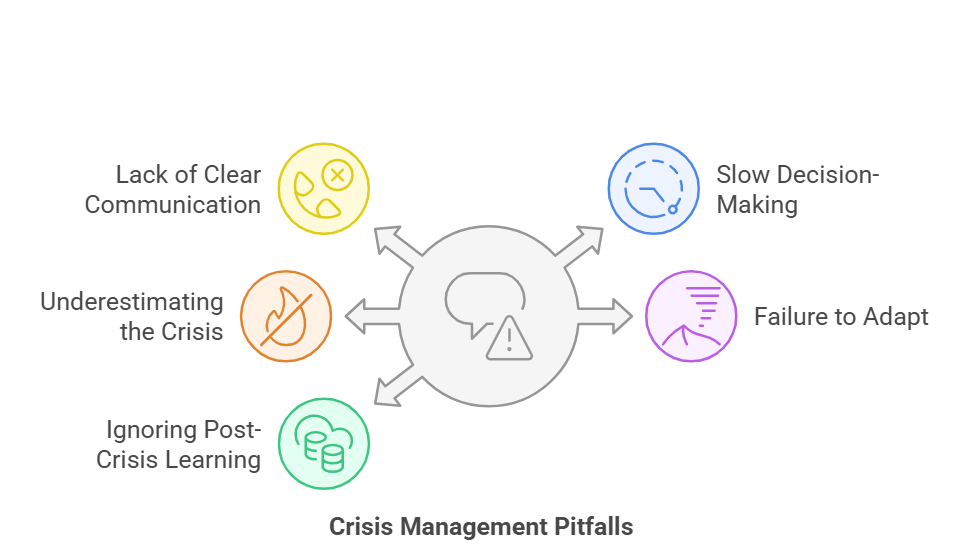
Even the best organizations stumble. Some of the most common pitfalls include:
- Lack of Clear Communication: Confusion over responsibilities or mixed messages can worsen a crisis. Clearly define what needs to be communicated, when, and by whom—to media, partners, employees, and suppliers.
- Slow Decision-Making: A fire must be controlled and extinguished before it engulfs the entire jungle. Delayed responses often make situations worse. Crisis management organisation Chart need to ensure that backup for key resources are marked.
- Underestimating the Crisis: Ignoring early warning signs or dismissing smaller incidents that could snowball into larger problems.In today’s digital age, it is not uncommon to see how a single piece of viral content can severely damage a reputation. Failing to act early can turn a manageable issue into a full-blown crisis.
- Failure to Adapt: A real crisis is neither planned nor fully anticipated. No matter how many drills we conduct, the actual crisis will always unfold differently. Rigidly following predefined protocols without adapting to the situation’s unique challenges can hinder an effective response. Flexibility and situational awareness are key to managing crises successfully.
- Ignoring Post-Crisis Learning: Organizations that fail to review and learn from past crises risk repeating the same mistakes. I have seen instances where basic oversights, such as misplaced cupboard keys or the lack of regular testing of crisis-handling kits and tools, have led to major inefficiencies during emergencies. Ensuring that all crisis management resources are fit for purpose and regularly maintained is crucial for effective response and preparedness.
Role of Technology in Crisis Management
Technology has revolutionized crisis response, making it faster, more coordinated, and highly efficient. Advanced platforms like Noggin, Everbridge, and D4H offer real-time solutions that enhance crisis management by enabling:
- Incident Reporting & Tracking: Quickly detects, logs, and monitors crises as they develop.
- Automated Alerts & Communication: Ensures timely and accurate information reaches all stakeholders.
- Resource Allocation: Helps deploy teams and critical resources where they are needed most.
- Data Analytics & Post-Crisis Review: Provides insights to refine strategies and improve future responses.
By breaking down silos and fostering seamless coordination, technology ensures that crisis management is not just reactive but proactive, data-driven, and continuously improving.
Crisis management is not just about reacting—it’s about being prepared, adaptable, and continuously improving. The best organizations don’t just rely on plans; they practice, refine, and evolve their tactics.
A well-structured crisis management framework, combined with clear roles, effective communication, and the right technology, ensures that teams can respond with speed and confidence. But true resilience comes from learning—every crisis is an opportunity to sharpen strategies, identify gaps, and strengthen organizational preparedness.
In the end, the practice of tactics ensures that when the real crisis hits, your organization doesn’t just survive—it emerges stronger.
Leave a Reply